Abstract
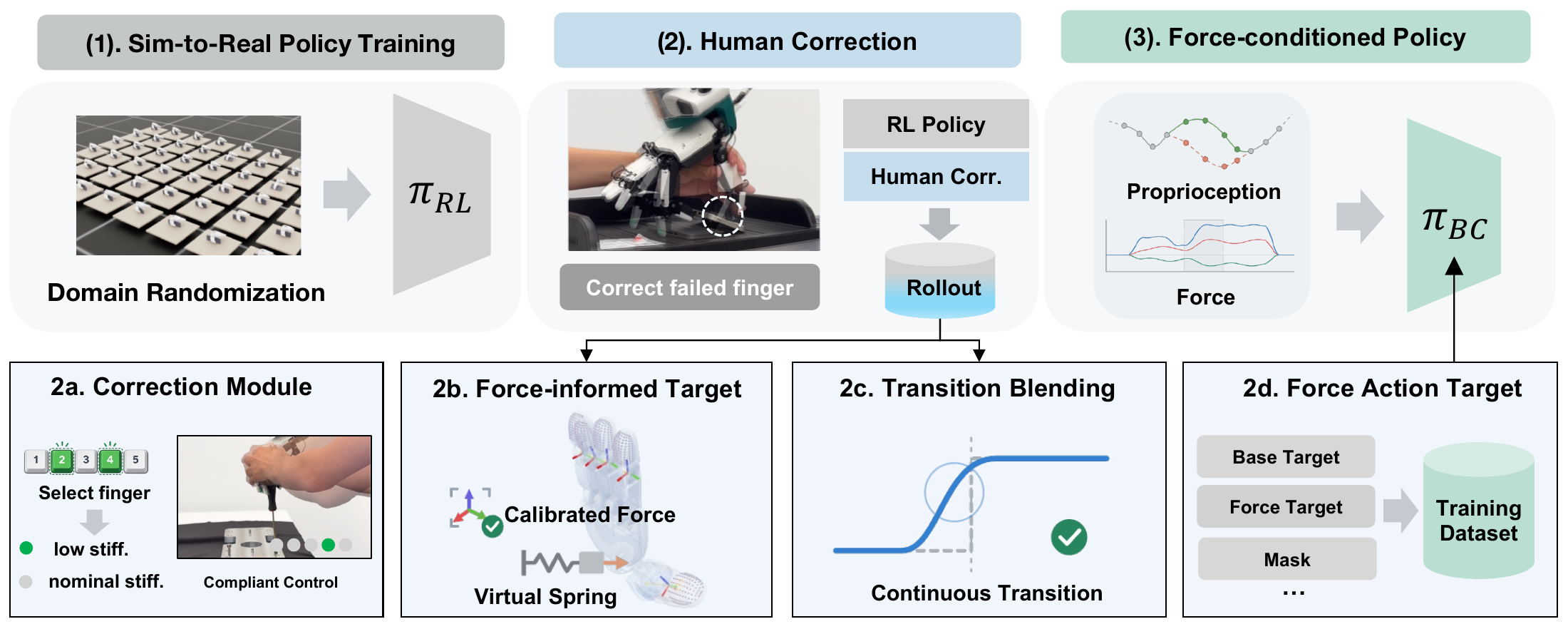
Dexterous manipulation policies trained in simulation often fail to transfer to the real world because of errors in contact timing and force regulation. Yet these policies can retain useful multi-finger coordination for task progression. We propose ReDex, a framework for adapting a simulation-trained base policy to the real world by correcting local contact failures and incorporating tactile feedback. Starting from a proprioception-only base policy, ReDex allows a human operator to physically correct contact failures at selected fingers under compliant control during real-world rollouts, while the frozen base policy continues to control the remaining fingers. These rollouts combine base policy execution, human-corrected finger motion, and fingertip force observations. We reconstruct force-informed targets from these rollouts to train a standalone force-conditioned policy via behavior cloning. This design reduces human correction effort, enables learning of contact regulation from real-world interaction, and introduces force feedback into a proprioception-only policy without tactile simulation or complex full-hand teleoperation. We evaluate ReDex on two challenging, contact-rich dexterous manipulation tasks on real hardware. Compared with sim-to-real transferred base policies, ReDex increases Object Flipping success rate from 14% to 86% across two objects and average Screwdriver Rotation progress from 26.0% to 95.3% across three objects.
Pipeline
Real-World Results
The repaired policies flip objects and rotate screwdrivers autonomously.
25 trials per object–method pair. Flipping: stable 90° reorientation. Rotation: progress toward 360°, measured in 90° increments. Base: simulation-trained RMA.
Policy Rollouts
All policy videos below are fully autonomous and shown at 1× speed, with no speed-up.
Cuboid Flipping
Cellphone Flipping
Screwdriver Rotation
Small Screwdriver
Large Screwdriver
How Humans Provide Help
Target reconstruction
Failure Cases
The phone slips out of the grasp during human correction.
The cuboid slides without completing the flip.
The flip completes with abrupt contact.
Finger motion does not sustain rotation.
Repeated regrasping produces little rotation.
The handle makes little rotational progress.
The cuboid drops back to the tray.
The cuboid stays tilted instead of flipping.
The screwdriver slips through the fingers and drops.